A/B testing for marketing teams in 2026: when it works, when it doesn't

Most marketing A/B testing advice assumes you have Netflix-scale traffic. You don’t. A typical B2B site gets 2,000-10,000 monthly visitors. A typical D2C brand gets 30,000-100,000. At those volumes, almost no test you run will reach statistical significance in a reasonable window — and pretending otherwise wastes months.
This is the honest framework we use across our portfolio. It’s less about p-values and more about deciding which tests are worth running at all.
Test only when the delta could be material
The first filter: would a 20% improvement in this metric actually matter to the business? If the answer is no, don’t test.
Examples of tests that meet this bar:
- Homepage hero CTA copy (drives top-of-funnel conversion)
- Pricing page layout (drives mid-funnel conversion)
- Onboarding flow first step (drives activation)
- Email subject line on a campaign with 50K+ recipients
Examples that almost never meet this bar:
- Button color
- Whitespace adjustments
- Header font weight
- Footer link order
The button-color tests became internet famous because Google ran them at scale. At your scale, even a real 20% lift would take 6 months to detect with confidence, by which point the underlying market has changed.
Sample size math, in plain English
To detect a 10% relative lift on a 5% baseline conversion rate at 80% statistical power, you need roughly 30,000 visitors per variant. 60,000 total. If your site gets 5,000 monthly visitors total, that’s a year-long test.
The rule of thumb that’s served us across 11 brands: if you can’t ship the test result in 6 weeks at a 95% confidence band, you don’t have enough traffic to test that hypothesis. Make a decision instead.
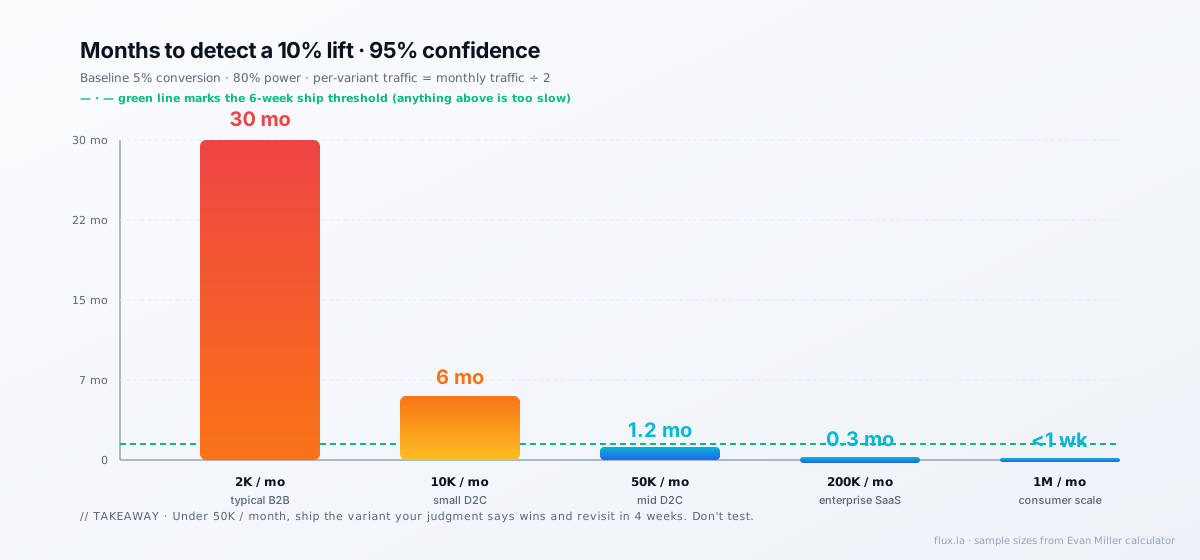
Use Evan Miller’s calculator to sanity-check sample size before starting. Most teams skip this and learn 8 weeks in that they were never going to reach significance.
What to do when you can’t test
This is the most under-discussed reality of small-team A/B testing: most decisions should be made via judgment, not stats.
Three frameworks we use when we can’t reach significance:
Look at the qualitative signal first. Run session recordings (we use Microsoft Clarity, which is free). If the variant fixes a problem you can SEE — users hesitating, scrolling past the CTA, abandoning a form — that’s a stronger signal than a 60%-confidence quant result.
Use external benchmarks. If your homepage conversion is 1.2% and similar B2B SaaS sites benchmark at 2.5%, you have headroom regardless of which variant tests “better” on your tiny sample.
Make a reversible decision and revisit. Ship the variant your judgment says wins. Watch the topline metric for 4 weeks. If it doesn’t get worse, keep it. If it does, revert. This is faster than testing for most small teams.
What to actually test
When you DO have the traffic and the delta would be material, here’s the priority order we use:
- Pricing page. Highest leverage. A 10% lift here moves topline revenue more than any other test.
- Top-of-funnel CTA copy and placement. A bigger top-of-funnel lifts every subsequent metric.
- Onboarding step 1. Activation drops here are catastrophic — fix this before testing anything downstream.
- Email subject lines (on lists over 50K). Highest-velocity test you can run.
- Paid ad creative. If you’re spending over $10K/mo on paid, creative tests pay for themselves fast.
Things we explicitly de-prioritize:
- Color tests
- Single-word copy swaps
- Anything below 1,000 weekly conversions
Tool choice
For small teams we use:
- PostHog — free up to 1M events/mo, ships A/B testing built in. Good for early-stage.
- VWO — solid for D2C with enough traffic to justify it.
- Google Optimize replacement — Optimize was shut down in 2023. The decent replacements are PostHog, VWO, and Convert.com.
For enterprise we use Optimizely or LaunchDarkly (the latter is feature-flagging primarily, but their experimentation works well).
How to read results when you don’t have significance
You’ll often hit a 90% confidence interval after 3-4 weeks but never close the last 10%. Two options:
Ship the leading variant if the cost of being wrong is low. A change to a homepage CTA that’s marginally better than the control is fine to ship at 80% confidence. You can revert.
Don’t ship if the cost of being wrong is high. A pricing page change at 80% confidence isn’t safe. Either run longer or change the test design.
The single most expensive A/B testing mistake
Running too many tests in parallel on the same audience. If you’re testing the homepage hero AND the pricing page AND the email subject line on the same week, the variants interact and you can’t attribute the lift to any one change. We’ve seen teams burn 3 months chasing a result that turned out to be one of three concurrent tests they didn’t realize were colliding.
Sequence, don’t parallelize. One major test at a time.
What we run for clients
For the clients we work with, we typically run 2-3 tests per quarter on the highest-leverage surfaces. Quality of judgment matters more than test volume.
If you want help figuring out which tests are worth running on your funnel — or whether you should be testing at all — tell us what you’re working on.
Related reading on this site:
- How SEO actually works in 2026 — the strategic frame that A/B tests sit inside
- Top 8 content marketing campaigns from 2024-2026 — examples that won without testing
Get next week's playbook in your inbox.
Biweekly. Operator-grade. No spam.
Alejandro Rioja
Operator who builds and sells marketing-focused brands. Founder of Pickleland, founder of Flux.LA, writing about AI SEO + GEO at alejandrorioja.com .